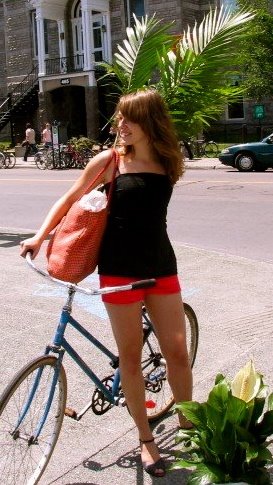
A letter to my Road King
Dear Beater Bike,
I don’t know where you are or how to find you. Maybe you don’t want to be found. I suspect you aren’t far. You’ve always loved Montreal in the summertime, and I am sure you still do, without me.
I was surprised how you left in the middle of the night; I thought I’d given you the security you needed. Now I’m left lacking closure and sometimes I find it hard to leave my house. Daily life has slowed without you, and it takes me twice as long to get anywhere, to do anything. It’s hard to pretend things are normal.
It’s not that you were the only bike in the world for me. I mean, I’ve had rides in better shape than you, slicker and younger, but I was willing to work it out. But you? What did you do for “us”? Sure we went everywhere together, but do you remember how you hurt me?
When we decided you were ready to let your chain guard go, I thought things were getting better. We were finally able to enjoy a special silence; things were going smoothly. You looked and felt ten years younger. But, it wasn’t long before remnants of your sordid past resurfaced, and you let me slip on your broken pedal and gouge my ankle on your useless, rusted parts. When I suggested we get professional help for these, the last of your hang-ups, you proved to be a difficult case. After that, I wasn’t sure you wanted the help. It wasn’t my fault you were scarred, yet it was me who paid the price. I hope you know that I did everything I could for you. I couldn’t afford to give more. We were good together.
Don’t you remember what a mess you were in when I found you? You were rusting in the snow, twisted and broken by a sidewalk plow hit-and-run, a junkie standing over you, anxious to snatch you away. Your fate was so uncertain. Had I not left the bar at exactly the right time, who knows what might have happened to you that night.
I did everything I could to get you back on the street again. How could you leave like this after all I’ve done for you? I want to think you couldn’t help yourself, or that you’ve gone off to serve a greater purpose. But, I met someone who saw you leave. He said you sold yourself for the cost of a hit.
Loving you was risky, but I’d hoped I’d be able to care for you in a way that could keep you from getting sucked back in by the junkies and crack whores who seemed to know you, and your kind, so well.
I would like to think that you’re enjoying the sunshine somewhere, rolling down a bike path not far from here. I half expect to see you to ride past me, some other girl on your saddle. Just know that I still want you. And, if I find you, I’ll want to chain you up and keep you with me forever. You’ll always be my Road King.
Tuesday, June 26, 2007


Friday, June 22, 2007
Six-dollar coffee and a coming of age
The fair trade coffee would take minutes longer to prepare than regular brew, she warned me with a hand-rolling gesture that implied eternity. She didn’t tell me it would cost $6 for a to-go cup. I was already feeling guilty for not brewing my own at home, for not bringing my own reusable container, and for ignoring the current strain on my finances.
Then, I realized I’d misunderstood her. Silly me. How could a single cup of regular filter coffee sell for what nearly constitutes a basic hourly wage in some Canadian provinces?
It can. And it does at this mediocre cafe. The “coffee agent” reassured me I’d heard correctly. How can a cafe ethically advertise that they offer fair trade coffee when they package it in such a way that it becomes unaffordable? It’s a ruse.
Since the coffee cost me more than it was worth, I am making it into something bigger than it is. I am assigning the now cold, exorbitantly-priced beverage symbolic value as an offering to the goddess of debt.
This is the year I begin my worship of this, the least compassionate of modern North American goddesses. Only by appeasing this deity will I prevent my own head from rolling, and eventually free my own palpitating heart from her merciless grasp.
Her voice resonates at every sales counter, restaurant and ATM. Her minions monitor my every transaction. She owns me. I am her bitch.
Even though Revenue Canada has misspelled my name on my tax installment forms, I must accept responsibility. Even though my ex-boyfriend emotionally abused me following our break-up, I must continue to pay off the shared Visa bill and its impossibly high interest rates. Despite having graduated from university seven years ago with a degree that would get me nowhere, I continue to make monthly loan payments. And then there are the bills, rent and birthdays. There is no space in my life for $6 coffees.
From this day forward, I acknowledge her power over me and my every decision. I pledge to give her what she craves. I will make sacrifices of my own so as not to be condemned to financial ruin and seven years of purgatory. I will follow carefully planned financial budgets and travel only when I am financially secure. I will swallow my pride. I will no longer see red.
As soon as I have my soul back, I’ll have the freedom to save for my future and address my deficits and responsibilities to humanity and my own personal development. I’ll have true freedom of choice and I will get down to business.
For the record, when that time comes, I still won’t buy $6 coffees.
Thursday, November 23, 2006
My stint as a half-naked security guard
So what if the security guard at the guest-house shoots at tourists with his cap gun? He only does it because we know he's joking. Right?
That's why I love Nicaragua; even in its cities I felt safe. I treated myself to solo walks. Alone. Alone and thinking, my mother would have a heart attack.
The colonial architecture was stunning. So were the colours. And, the lifestyle. About a block from my guest-house, an abandoned, turquoise colonial-era building was "infested" with small green parrots. Parrots. Think about that.
Reveling in this sensation, but tired, my Australian travel-mate and I decided to stay in and rest, on our first night in this new city. We bought a bottle of the local brew to enjoy after hours in the common room of the guesthouse. Its windows opened to the street where a total of four security guards, seated in rocking chairs, protected the entrance. 
At first I thought this was simply over-staffing, but each guard had hidden a bottle of beer behind his rocking chair. This wasn't an opportunity to analyze their staffing policies, it was a party. Within minutes the two guards who were actually on the job invited us to join them.
None spoke English, but they were happy to repeat themselves until I understood well enough to translate for my blonde, busty Australian friend. They were both surprised and delighted that we’d accepted. Offering us their rocking chairs, they ran across the street to ask the closed bar to reopen. I’m not sure if anyone paid for the drinks, but they were free for us, and the bar kept serving until we went to bed.
They asked the usual questions and teased each other about their competency, both as security professionals and husbands. They asked about my home in Canada (and whether it was really as cold as they say), and I asked about theirs around the corner. The guard seated closest to me argued that hammocks are infinitely more comfortable than beds. I heartily agreed, until I realized what he was getting at.
 The city is safe, even for a tourist like you, he reassured me, checking out my legs. Of course it is safe, I said, hoping to change the path of the conversation. I carry this! And, I showed them the handmade catapult I'd picked up at the local market. Ultimately, I carried this weapon in my back pocket from Nicaragua to Panama. As was intended, they laughed at me. And then, they pulled their weapons.
Taking turns demonstrating how each was used, they had me both fascinated and nervous. I mean, they were drunk. Mostly, they used clubs and cuffs, but the head guard also carried a cap gun that he fired freely at hotel guests and passers-by.
Exactly then, a larger and drunker man stumbled down the road in front of us and toppled over. His nimble limbs bounced back from the dusty road when he fell and hit him in the face, adding insult to injury. The head guard rose to “address the situation” as the man unsuccessfully tried to stand. The borracho was twice his size, and we wondered what he could possibly do.
I was worried he would try to impress us with his authority, but that too was short-lived. His friends tapped me on the arm and, through their laughter, suggested I help him. One of the guards removed the shirt of his uniform and handed it to me. I put it on. It hung to my knees, giving the impression that I was without pants. Handing me his weapons, after a brief lesson on using the telescopic billy club, he urged me toward the scene of the crime.
While I feared this might qualify as a bad idea, I couldn't resist. Like a regular tough-guy, I walked to where the head guard was attempting to reason with the drunk. I arrived in my new uniform, my weapons hanging benignly at my side. As stunned as the guard, the borracho realized he was outnumbered, threw up his arms and surrendered.
Never in my life had I imagined having a man surrender to me like this.
Back at the guest-house, the remaining guards rolled on the sidewalk in hysterics. The drunk was none the wiser and we escorted him home, less than 30 feet away. The raucous laughter had wakened his wife and mother who now stood, annoyed and confused, to receive him in the doorway of their home.
Satisfied that we'd entertained the locals enough for one day, and having promised to join them again during their next shift, my Australian friend and I retired, leaving the dirty work to the professionals.
Tuesday, November 14, 2006
Welcome to Nicaragua. There are no seat belts to fasten.
Public washrooms were few and far between, but it seemed unwise to interrupt Nicaraguan police as they dragged a hand-cuffed man across the parking lot, kicking him in the ribs.
 His partner, I assume in crime, was already subdued, and kneeled with his head hung in preparation for another blow. The beating had just begun. We were going to have to hold it, and look for another toilet.
It was only days after we’d been shot at in Honduras*, and I continued to travel with the same group; informal ambassadors of the Commonwealth with a collective sense of humour that ranged from dry to wry. Less than an hour inside the Nicaraguan border, we already joked about dodging bullets, but this scene in the parking lot left even the most seasoned of travellers among us affected. That’s right, we remembered. We need to be cautious of police, too.

Still, despite its reputation and a sour introduction, we believed we’d be safer and happier in Nicaragua. Already we’d noticed the relative absence of litter on the roadside and our moods were lifting. When we arrived in Managua and realized mojitos cost the equivalent of a Canadian dime, we indulged.
In the morning, parched, I would choke on gases at the rim of my first active volcano (temporarily overcoming my fear of death by fire), descend into a bat cave and take a tumble in guano (overcoming my fear of closed spaces and death by exposure to toxic feces), and spook myself in a Sandinista prison, as I imagined which graffiti was carved by prisoners and which by drunken teenagers after the fact.

 That day I would learn that some of those prisoners met their end in that same volcano I’d visited earlier, and that their mothers still toss flowers to them. I would recall the shape of the crater and its sand and pebbles (as seen above), and reluctantly imagine sliding to the inevitable.
Leaving Managua, we asked around to determine which buses were heading south to Granada. It seemed we had our choice of decommissioned U.S. school buses, deemed unsafe for paved North American rural routes, but relatively fine for maximum speed and passenger capacity on winding dirt roads in Central America.

Always the cheapest option, these so-called "chicken" buses are notorious. Some attribute the moniker to passengers who board with small livestock. Others say it's due to the way passengers are literally packed in like chickens, until not another body can fit in or on the bus. Some argue it is because they ramble at maximum speed down the middle of roads, playing chicken like it’s 1956 in Middle America. As a seasoned passenger of these buses, I will argue it’s a little of each.
Taking deep breaths and mustering faith in humanity, we passed our backpacks to the steward whose mission it was to tether them to the roof of the old bus. We’d have to watch to make sure that they remained there at each stop. Bags go missing often and swiftly, but there was no room for them inside with the livestock. As it was, there was standing space only, and the ride would be a few hours long.
There were a few things I’d come to expect from Central America, and some inalienable truths I’d come to accept. For example, upon realizing there was standing room only, I knew someone would try to look up my skirt. Second, it would be assumed that I couldn’t understand what anyone said. And, once they realized, they would laugh and ask the usual questions. Where are you from? Are you married? Why not? Do you have children? Why not? When will you?
Because I believe people ask questions about things important to them, I always reciprocate. That, and I'm curious, too. I asked women about their own children, and whether they were married. I was surprised that, while many had long-term partners, there were also a lot of single mothers and unmarried couples. It was children that seemed most important, and on this subject the cultural rift between us was most evident. Upon learning my age, I felt I was looked on with pity. For the first time, I felt spinsterly.
Then, I would be told I am beautiful and that I have beautiful eyes because they are green. I returned compliments like I did questions if I was speaking with a woman and, if I was feeling saucy, sometimes if it was a man, which always made his friends laugh.

This brings me to the final inalienable truth: Travelling by local transportation in a country that is fairly new to tourism, where you are visibly different and culturally awkward means you are inherently entertaining. When travelling as a sunburnt group, this is especially true.
Music is everywhere, especially on buses and in taxis. Music in English, however, is not. So, when Stevie Wonder "called to say I love you”, so did we. By the end of the song, we’d developed a choreography and the regular passengers were embarassed for us. Fortunately, I have selective comprehension of Spanish - and, English for that matter.
[As a minor aside, did you know that each Central American country has its own term for "tourist"?]
Depending on the length of a particular "chicken" bus trip and therefore time for conversation, I could expect to be questioned about my companions, join in with poking fun at their sunburns (I was always very careful to avoid becoming pink myself), sample food brought from people's homes, speak of places to visit, and appreciate list upon list of names of emigrated relatives. This ride was no exception, and that leads me to the final inalienable truth: "Chicken" buses are the only way to travel.
* See the Sept 21, 2006 entry for the story of shots fired in Honduras
Friday, October 20, 2006
Spanish 101: Sex, drugs and masturbation
I’ve said things to Latin Americans this year that I would never intentionally say to anyone. I was fooled into thinking I could speak Spanish very early on in my altogether six-month trip throughout the region. As there was no shortage of encouragement and enthusiasm from the locals, my conversational confidence quickly surpassed my actual ability - a dodgy dynamic.
The following three anecdotes, in chronological order, will demonstrate how people with a little bit of knowledge can be more dangerous than those with none.
On asking an elderly woman first for drugs, then sex*:
My first significant blunder occurred my first solo day in Mexico. Determined not to be shy about speaking Spanish lest I get lonely, I went to the local market in search of souvenirs and unwitting practice partners. Starting with simple interactions intended to build my confidence, I stepped into a bakery and smiled at the elderly woman seated behind the counter. She threw me a familiar look that I now recognize as a mixture of amusement and dread – a common response to novices of the language. She'd correctly assumed I was about to blabber gibberish and expect a response.
I’d read of a delectable regional specialty, little coconut squares, but had forgotten what they were called. As I began to describe the dessert the señora’s jaw fell and she leaned forward to examine me. The look of amusement-dread contorted to total disbelief. At the time, I had no idea why.
Weeks later, as my skills had improved, I recounted the tale to Mexican friends in hopes of shedding some light. My pronunciation, they explained, was the culprit. Apparently, within seconds of entering the shop, I accidentally asked the señora for cocaine. Delicious sweet squares of cocaine that I’d read about in travel books. I love sweet cocaine, I told her, and I would like to learn how to make some myself.
Realizing I had no idea what I was saying, the señora began to laugh. Gaining momentum, she laughed until tears flooded the deep pockets of folded skin beneath her eyes and flowed over her cheeks, landing on the front of her blouse. That sort of laughter is contagious, and having acknowledged that I’d said something wrong, I adjusted my pronunciation through my own nervous chuckle.
True to my memory, I repeated the dialogue for my Mexican friends to help me understand where I may have gone wrong. Not so delicately, they revealed to me that I had stopped asking the señora for cocaine and asked instead for a vagina; a sweet square of vagina. Except, the way I asked for it wasn’t even that polite.
With this request, the señora surrendered to hysterics and, unable to catch her breath, laid her head on the counter, her face behind her arms. She could no longer speak. Tears streamed from her eyes; eyes that have seen 90 years of history pass, and still, I had the feeling I was the most ridiculous person she’s ever met. Her head still on the counter, she blindly waved me out of the store. Still clueless about the details of the interaction, I saw the coconut squares on my way out, and decided to pass.
*Those of you familiar with Mexican slang may be able to guess the words to which I refer.
On cross-dressing:
It was no secret. This Mexican bad boy from Tijuana was into me. It was also obvious that he would have been into me no matter what I looked like, smelled like, or said. I was a novelty. We’d met him and his friends earlier, at a town fiesta, and were, at this point, lounging on the beach. He spoke no English, and I still struggled with Spanish. Still, his intensity was unsettling and, since we’d planned to stay with the group for the rest of the day, I felt the need to break the tension and perhaps cool the train his thought was on.
Quick inventory of my limited vocabulary and key phrases left me with little to work with. I decided not to ask him where the bathroom was, not to ask him his name (again), and definitely not to ask him for another cerveza, por favor. Asking if he had any rooms or beds available wouldn’t serve my purpose either, so I decided to claim I was hungry. It was all I had left. The first time I said it, he just squinted and continued to invade my personal space. So, I said it again, thinking perhaps I’d pronounced it wrong. He chuckled a bit, and I think he asked me to repeat it. I tried my best, over and over. "I am hungry," I said. "I am hungry. Hungry. Me. Hungry."
He looked very, very confused. I patted my belly to get the point across. "Hungry. Me. I am hungry."
Abruptly, he launched himself away from me. I had not anticipated the effectiveness of my hunger tactic and was shocked. The bad boy looked terrified and stared at my bikini bottoms in disbelief.
The word for hunger, you see, is “hambre”. The word for “man” is “hombre”. For the record, the verbs are confusing, too. Here is what happened:
Tengo hambre means, “I am hungry.”
Soy hambre, mispronounced, means, “I am a man.”
I’d convinced the homophobic bad boy he’d been hitting on a man, and that man was me. Reversing the damage was likely the most uncomfortable act of miming in modern history.
On asking a classmate about masturbation:
I want to tell you that by the time I made it to Argentina, months later, I stopped embarrassing myself with incredibly inappropriate language mix-ups. But, I’m no liar.
Fellow North American and language student, my last victim was enrolled in my Spanish class in Buenos Aires. He was a little shy and lacked my, albeit pitiful, mastery of the language, so I tended to dominate the conversation. On this particular day, we were learning how to use more complex verbs; and how to use these teeny, tiny little words in front of those verbs that can change the entire meaning of what you say. I thought I understood and, to practice, began to ask the shy man questions about his hobbies and pastimes.
Finally finding the words to explain that he was learning to play guitar, he looked nearly discouraged when I posed another question. I asked him how often he played. This is where it gets complicated. The verb in Spanish, tocar, is used to describe the act of playing an instrument and also means “to touch”. And, when one of those teeny words I mentioned earlier gets in the mix, well, the context changes quickly.
The instructor’s face turned crimson and I realized what I’d said. She tried to find the politest possible words to explain the difference to me and to the student, who, although he didn’t understand the mistake exactly was already instinctively blushing.
I’d inadvertently asked the shy novice, “How often do you touch yourself?”
Subscribe to:
Posts (Atom)